// Guides
What agentic AI actually means for short-term rentals
July 2026
The term everyone uses and nobody defines
“Agentic AI” is the phrase of the moment. It is in every webinar title, every vendor email and every LinkedIn post about the future of property management. The trouble is that almost nobody says what it means, so it has come to signal “AI, but newer” and not much else. For an operator trying to decide where to spend a limited budget, that is worse than useless. It makes it hard to tell a genuine capability from a rebranded chatbot.
So here is a plain definition, from people who have run this technology inside short-term rental companies. An agent is software that can take a goal, work out the steps, and carry them out inside your real tools, checking its own work along the way. “Agentic” just means the software acts, rather than waits to be asked. The distinction matters because it changes what the technology can actually take off your team’s plate.
Automation, chatbot, agent: three different things
These three words get used as if they are interchangeable. They are not, and the difference is exactly what decides whether AI helps your operation or quietly creates more work.
- An automation follows a rule. “When a booking is confirmed, send this message.” It is reliable and it is blind. Change the situation even slightly and it either does the wrong thing or nothing at all.
- A chatbot answers a question. It can hold a conversation and sound helpful, but it stops at the edge of the chat window. It cannot open your PMS, check the cleaning schedule or escalate a real problem to a person.
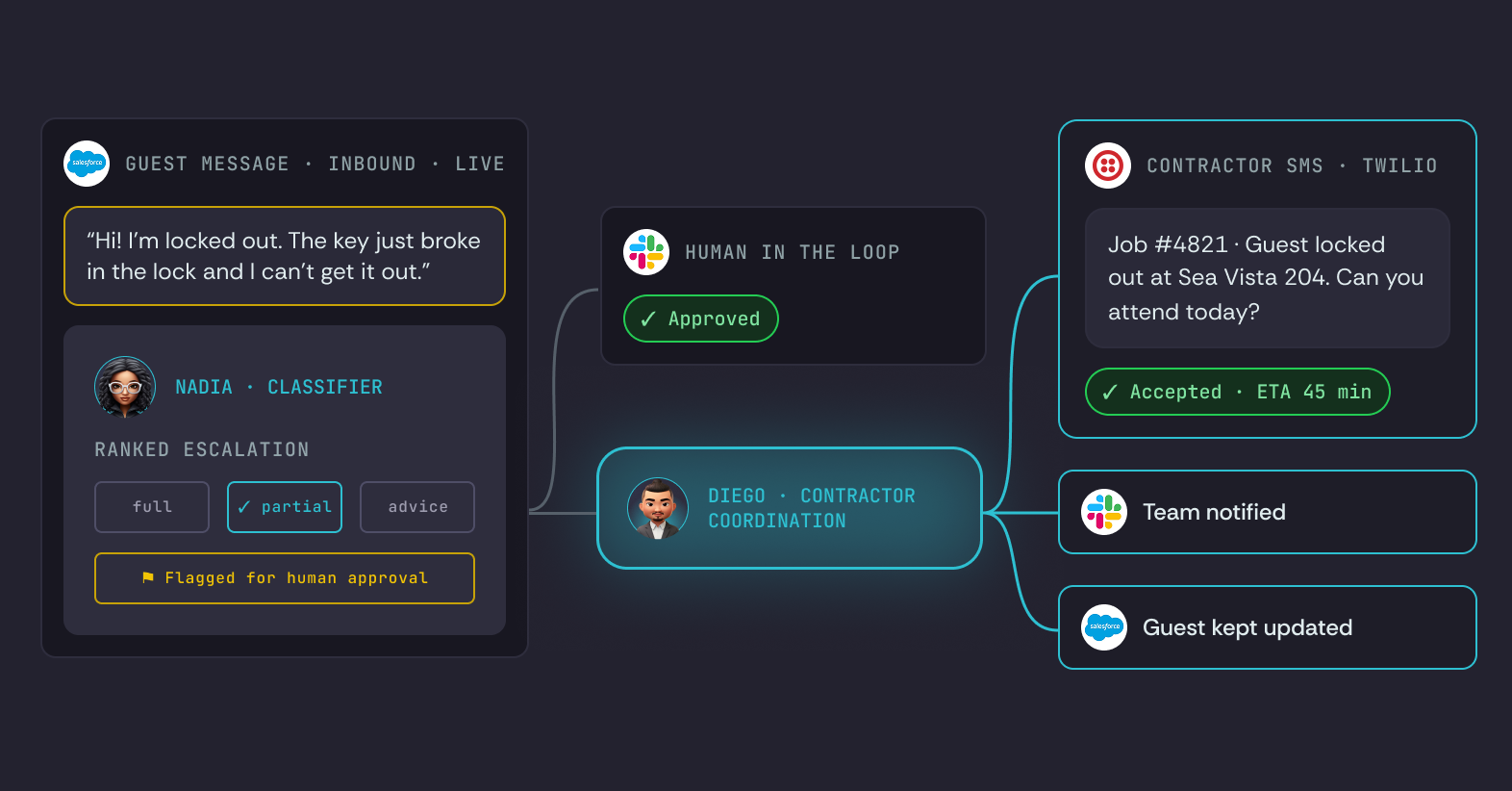
- An agent completes a job. It reads the guest message, checks your booking and your knowledge base, works out what the guest actually needs, answers them, and if the job needs an action in another tool or a human decision, it takes that action or hands it over. It is judged on the outcome, not on the reply.
An automation follows a rule. A chatbot answers a question. An agent completes a job.
What that looks like in a short-term rental operation
Picture a guest messaging at 2am: “The wifi isn’t working.” An automation cannot help; there is no rule for this. A chatbot might paste a generic troubleshooting list and hope. An agent does the job. It reads the message, identifies the property, pulls the correct network name and password from your knowledge base, sends clear steps in your voice, and checks whether other guests at that property have reported the same fault. If the router is genuinely down, it does not keep the guest going in circles. It logs the issue, flags it to your on-call person, and tells the guest a human is on it. The guest is looked after, and your team wakes up to a clear note rather than an angry review.
That is the shift. The work is not “answering messages”. The work is resolving the situation, and an agent is the first kind of AI built to do that inside the tools you already run.
Why one agent is not enough
A real operation is not one job, it is many jobs happening at once, and they overlap. Guest communication runs into operations the moment a guest reports a broken heater. Operations runs into reporting the moment an owner asks why their unit was offline for a night. A single agent trying to do all of it becomes the same over-stretched generalist you were trying to relieve.
This is why ScaleGX builds squads rather than a single bot. A squad is a set of specialist agents, each owning a part of the operation, with routing and supervision between them. Guest comms handles the conversation, passes the maintenance issue to operations, and operations feeds the outcome into reporting. When something falls outside what any agent should decide, it escalates cleanly to a human. One agent answers. A squad runs the operation.
What to look for before you trust any of it
Agentic AI is only as good as what sits underneath it. Before you let any of it near a guest, look for three things.
- Real integrations. The agent has to genuinely connect to your PMS, channel manager, CRM and ops tools, not screen-scrape or rely on you copying data across. Actions in your real systems are the whole point.
- Guardrails. It should know what it is allowed to decide and what it must hand to a person, and it should fail safely, escalating when it is unsure rather than inventing an answer in front of a guest.
- Someone maintaining it. Models change, APIs change, your operation changes. Without someone tuning and monitoring it, an agent that worked in the demo drifts out of true within months.
What a squad could look like on your operation
Agentic AI is not magic and it is not a widget. It is specialist agents, properly integrated and supervised, doing real jobs inside your operation. The interesting question is not “what is agentic AI”, it is “which of my jobs would I trust it with first”. That is a conversation worth having with people who have run these operations from the inside.